




The relationship between sleep and chronic pain—and why a difficult night can change how your body feels the next day
| Overview: The Sleep-Pain Connection
In this article, we’ll look at:
You finally fall asleep after shifting positions for what feels like the tenth time. A few hours later, your hip wakes you up. Then your back. By morning, the alarm goes off, and everything seems to hurt a little more than it did the night before. If you live with chronic pain, that pattern may be familiar. Pain can make it difficult to fall asleep or stay asleep, but the relationship also works in the other direction: a poor night’s sleep can influence how strongly you experience pain the following day. Research increasingly describes sleep and chronic pain as a two-way relationship. In fact, a 2025 systematic review found that nighttime sleep quality was a more consistent predictor of next-day pain intensity than pain was of that night’s sleep. That doesn’t mean poor sleep caused your chronic pain or that better sleep will make an underlying condition disappear. It does mean that sleep deserves a place in the pain conversation. Pain is influenced by more than the location that hurts, and our guide to the pain-brain connection explains why the brain and nervous system can become increasingly important when pain persists. |
Pain and Sleep Can Feed Each Other
One side of the cycle is easy to understand: when something hurts, sleep can become harder. Back pain may make your usual sleeping position uncomfortable. Neuropathy can make the weight of bedding against your feet difficult to tolerate. Shoulder pain may prevent you from lying on one side, while arthritis, headaches, muscle tension, or post-surgical discomfort can make settling down difficult in the first place.
Pain can also wake you after you fall asleep, leaving the night fragmented even when the total time spent in bed looks adequate.
Then morning arrives, and the cycle begins again.
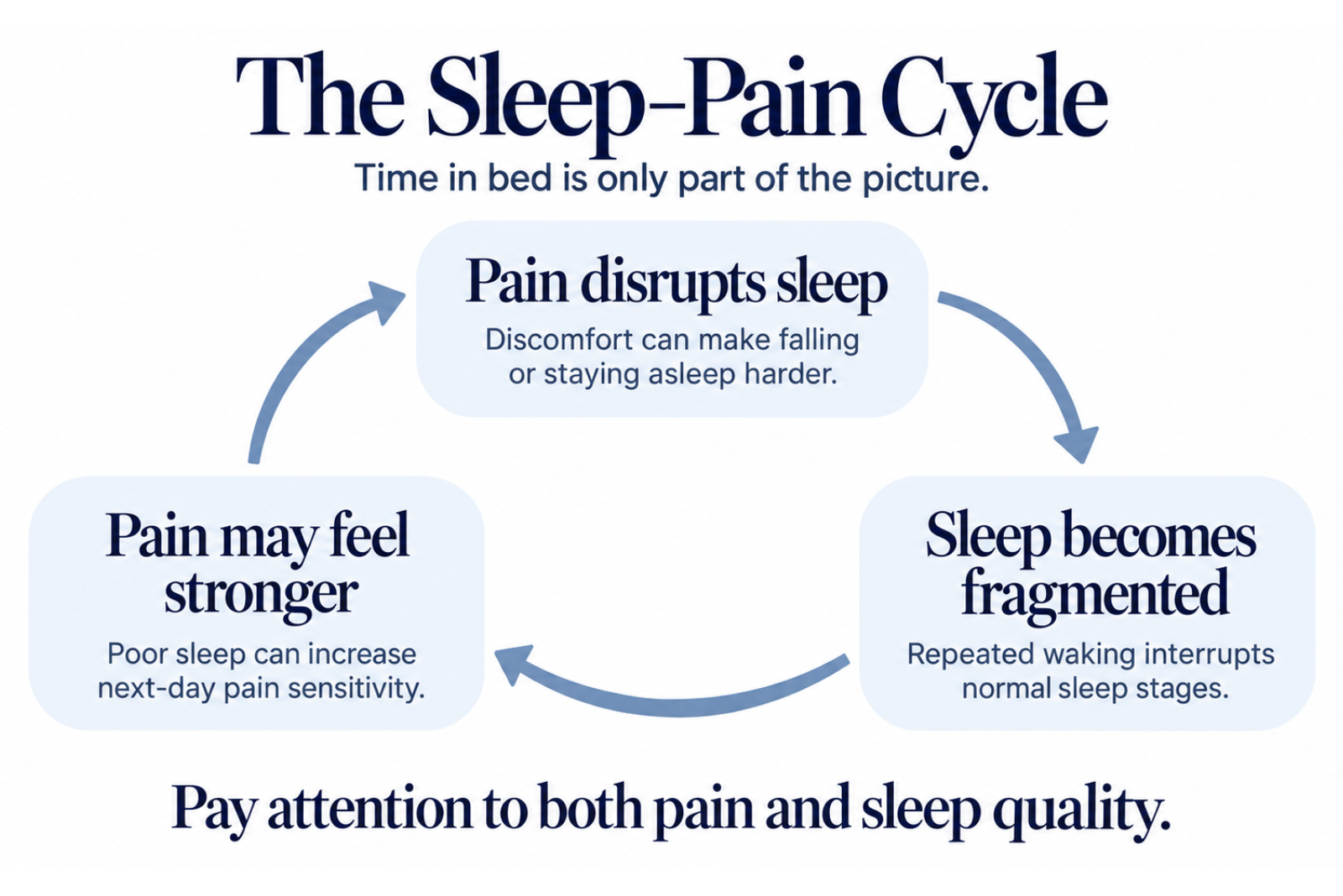
Research shows that poor sleep can make us more sensitive to pain, while ongoing pain can make it harder to sleep well. Large studies involving hundreds of thousands of adults have found that these two problems can reinforce each other over time.
In other words, pain may keep you awake tonight, and a difficult night may leave that same pain feeling harder to manage tomorrow.
That’s why it can be helpful to stop thinking of poor sleep as simply an unfortunate side effect of hurting. Sleep may be part of the pain cycle itself—and improving it may be one important part of managing chronic pain.
For a broader look at what inadequate sleep can do throughout the body, read 3 Surprising Effects of Sleep Deprivation and 4 Natural Fixes.
Why Can Pain Feel Stronger After Poor Sleep?
Pain isn’t simply a measurement of what is happening in a muscle, joint, nerve, or other tissue. Signals travel through the nervous system to the brain, where they are interpreted alongside other information, including previous injuries, inflammation, stress, mood, and sleep.
That means how well you sleep can influence how strongly you experience pain.
Research has found that too little sleep—or a night that is repeatedly interrupted—can make people more sensitive to pain. Scientists are still studying exactly why, but sleep appears to affect several systems involved in how the body and brain respond to pain, stress, and inflammation.
You may recognize the effect without knowing any of that science. After a restorative night, you may have more physical and emotional capacity to deal with an uncomfortable body. After several nights of interrupted sleep, the same painful area may feel harder to ignore, movement may require more effort, and getting through another uncomfortable day can simply feel harder.
That doesn’t make the pain imaginary or mean that it is “all in your head.” The brain and nervous system shape how every person experiences pain—and sleep can influence how that system responds.
Our guide to microcurrent and nervous-system regulation explores this relationship in more detail.
Sleep Quality Matters, Too
Eight hours in bed does not necessarily mean eight hours of restorative sleep. Someone may technically go to bed at 10 p.m. and get up at 6 a.m. but wake repeatedly because of pain, hot flashes, bathroom trips, noise, breathing problems, restless legs, stress, or another health concern.
That fragmentation matters. Sleep occurs in repeating stages throughout the night, and repeatedly waking can alter the normal progression through those stages. This is one reason it can be useful to look beyond How many hours did I sleep? and consider how well you actually slept.
Ask yourself:
- Did pain make it difficult to fall asleep?
- Did discomfort wake you during the night?
- Were you able to return to sleep easily?
- Did you wake feeling reasonably restored?
- Is daytime fatigue changing how much you move?
- Are you relying on more caffeine because you’re exhausted?
- Has your sleep changed at the same time your pain changed?
Those patterns can provide useful information. If sleep itself has become the bigger problem, our guide to sleep myths and natural aids takes a deeper look at improving the quality of your sleep.
Recovery Happens Outside the Workout, Too
Sleep also plays an important role in how well your body recovers from the things you do every day.
Exercise, walking, gardening, physical therapy, household work, and other activities all demand a lot from your body. When you’re sleeping well, you may recover comfortably and be ready to do those things again the next day. When sleep is repeatedly interrupted, that same activity may feel harder to bounce back from.
You might take the same walk you’ve done dozens of times but feel unusually sore the following morning. A workout that normally leaves you pleasantly tired may suddenly require two days of recovery, while an afternoon in the yard may leave your back more uncomfortable than expected.
Poor sleep isn’t necessarily the only explanation. Strength, nutrition, hydration, medications, illness, injuries, age, and underlying health conditions can all affect recovery. But when your body isn’t bouncing back the way it usually does, sleep is worth looking at alongside everything else.
This becomes especially important as we age. Staying active, strong, balanced, and independent matters, but so does giving the body what it needs to keep doing those things. Our blog post Healthy Aging: Mobility, Energy, and Independence explores that bigger picture.
Stress Can Follow You Into Bed
Sometimes you’re exhausted, but your body and mind still don’t seem ready for sleep.
You may have spent the day managing pain, working, caring for someone else, keeping up with appointments, or simply trying to accomplish ordinary tasks in a body that requires more attention than it used to. Then bedtime arrives, the distractions disappear, and suddenly you notice every sensation.
Stress and pain can both make it harder for the body to settle into sleep. After several difficult nights, you may even start going to bed already wondering: Will my hip wake me again? Am I going to be exhausted tomorrow? Which position is going to hurt tonight?
That doesn’t mean worrying caused your pain. It means pain, stress, sleep, and the nervous system can begin affecting one another when the cycle continues.
This is one reason our team looks at the nervous system alongside chronic pain rather than focusing only on the body part that hurts. Why Feeling Safe Matters for Healing: Polyvagal Theory and Chronic Pain takes a deeper look at that connection.
When Pain Is What Keeps Waking You Up
If a particular body position hurts, consider whether pillows, mattress support, or positioning changes reduce pressure on the area. If you consistently wake because of the same painful joint or body part, that pattern is worth discussing with your healthcare provider.
New or worsening nighttime pain also deserves attention.
Particularly when it is accompanied by symptoms such as unexplained weight loss, fever, weakness, numbness, bowel or bladder changes, chest pain, breathing difficulty, or another significant change in health.
Sleep problems themselves may also need evaluation. Persistent insomnia, loud snoring, gasping during sleep, significant daytime sleepiness, restless legs, or other ongoing sleep symptoms shouldn’t automatically be blamed on pain.
Sometimes improving sleep means treating the sleep problem. Sometimes it means treating the pain more effectively. Often, it means looking at both.
What Can Help Break the Sleep-Pain Cycle?
When sleep and pain have been affecting each other for a while, the answer usually isn’t one perfect bedtime trick. Instead, start with the basics that help regulate sleep consistently:
- Keep your sleep and wake times reasonably consistent.
- Get daylight exposure and move during the day when you can.
- Pay attention to whether late-day caffeine is affecting sleep.
- Be aware that alcohol can make you sleepy initially while still disrupting sleep later in the night.
- Make your bedroom comfortable, dark, and appropriately cool.
- Develop a wind-down routine that gives your body and mind a transition into sleep.
- Address pain rather than simply trying to sleep through it.
- Seek medical help when persistent sleep problems or changing pain patterns need further evaluation.
For more practical strategies, see How to Get More Restorative Sleep.
Are You Moving?

It also helps to pay attention to your activity during the day. Long periods of inactivity because you’re exhausted can sometimes make stiffness and deconditioning worse, while pushing far beyond your current capacity can leave you too uncomfortable to sleep.
The right balance may change from day to day. Enough movement to support function, enough recovery to tolerate it, and enough sleep to do it again tomorrow is a more useful target than trying to perform perfectly in any one category.
Learn more in our article, 4 Low-Impact Exercises for Pain Relief.
Where Microcurrent May Fit
At Pain Free For Life, we don’t approach every sleep problem with the same microcurrent protocol. If pain in a particular area keeps interrupting sleep, treatment may focus on the pain and its underlying cause. A painful knee may require a different approach from neuropathy, an old surgical scar, muscle tension, or a headache.
When prolonged stress or nervous-system arousal is part of the picture, a nervous-system-focused treatment may also be considered. Vagus Nerve Stimulation is one approach used within Pain Free For Life protocols to support nervous-system regulation. The appropriate treatment depends on the person, the device, the underlying concern, and what is actually interfering with sleep.
Where Conductive Ear Clips Come In
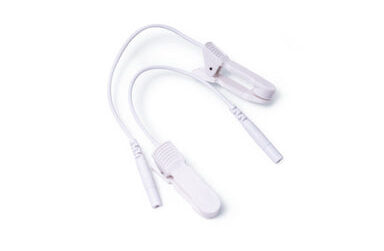
If you’ve seen photos or videos of someone using microcurrent with small clips attached to the ears, those are Conductive Ear Clips. They connect to a compatible Avazzia Life microcurrent device and deliver low-level current through contact points on the ears during certain protocols.
You can use the Conductive Ear Clips for the Alpha Ear Clips and Sleep Enhancement protocols, which can be beneficial for better sleep and other protocols that use ear-based treatment points. They aren’t a standalone treatment—the connected Avazzia Life device supplies the microcurrent.
For protocols requiring the 7–12 Hz range, compatible Avazzia Life devices include:
- Avazzia Life Genesis II
- Avazzia Life Evolution
- Avazzia Life Pinnacle Lite
- Avazzia Life Pinnacle
Our Pain Free For Life Avazzia Life Device Guide compares the current devices and can help you determine which options support the treatments you wish to perform.
You can also learn more about Conductive Ear Clips at The Sana Shop.
Sleep is closely connected with broader brain and nervous-system health, too. Our Microcurrent for Brain Health guide explores that connection in more detail.
Better Sleep Is About More Than the Number on the Clock
When chronic pain is part of your life, sleep progress may not begin with suddenly getting eight uninterrupted hours every night.
Maybe you find a position that lets you fall asleep more comfortably. Perhaps you stop waking every time you roll onto one shoulder. You wake feeling less stiff, have more energy for a morning walk, recover more easily after exercise, or notice that one difficult night no longer turns into an entire difficult week.
Those changes matter because pain and sleep can influence each other. Sleep deserves attention as part of chronic-pain care, not as an unrelated problem that happens after dark.
Pay attention to both sides of the cycle. If pain is stealing your sleep, ask what can be done about the pain. If poor sleep seems to be making everything harder the next day, ask what may be interfering with restorative rest.
Sometimes the most useful question isn’t simply How much does it hurt? It is also: How well am I recovering?
We’re Here to Help
Have questions about microcurrent therapy, Vagus Nerve Stimulation, sleep support, or choosing an Avazzia Life device? Our team is here to help and will respond within 48 business hours.
Call: 1-888-758-0851 in North America or 415-688-2045 internationally
Email: support@painfreeforlife.com
Text: +1 (415) 688-2045
For additional education on chronic pain, microcurrent therapy, nervous-system regulation, sleep, and whole-body wellness, visit the Pain Free Living Lab.
You can also visit The Sana Shop to explore Avazzia Life microcurrent devices, accessories, and other wellness tools.
Sources Cited:
Runge N, et al. The Bidirectional Relationship Between Sleep Problems and Chronic Musculoskeletal Pain: A Systematic Review With Meta-Analysis. Pain. 2024.
https://pubmed.ncbi.nlm.nih.gov/38809241/
Goossens Z, et al. Day-to-Day Associations Between Pain Intensity and Sleep Outcomes in an Adult Chronic Musculoskeletal Pain Population: A Systematic Review. Sleep Medicine Reviews. 2025.
https://pubmed.ncbi.nlm.nih.gov/39467486/
Kelleher EM, et al. Why Sleep Matters in Chronic Pain: Evidence Across the Lifespan. EBioMedicine. 2026.
https://pubmed.ncbi.nlm.nih.gov/41708400/
Sun Y, et al. The Differential Effects of Sleep Deprivation on Pain Perception in Individuals With or Without Chronic Pain: A Systematic Review and Meta-Analysis. Sleep Medicine Reviews. 2023.
https://pubmed.ncbi.nlm.nih.gov/36334461/
The Bidirectional Association Between Chronic Musculoskeletal Pain and Sleep-Related Problems: A Systematic Review and Meta-Analysis. Rheumatology. 2023.
https://pubmed.ncbi.nlm.nih.gov/37104741/